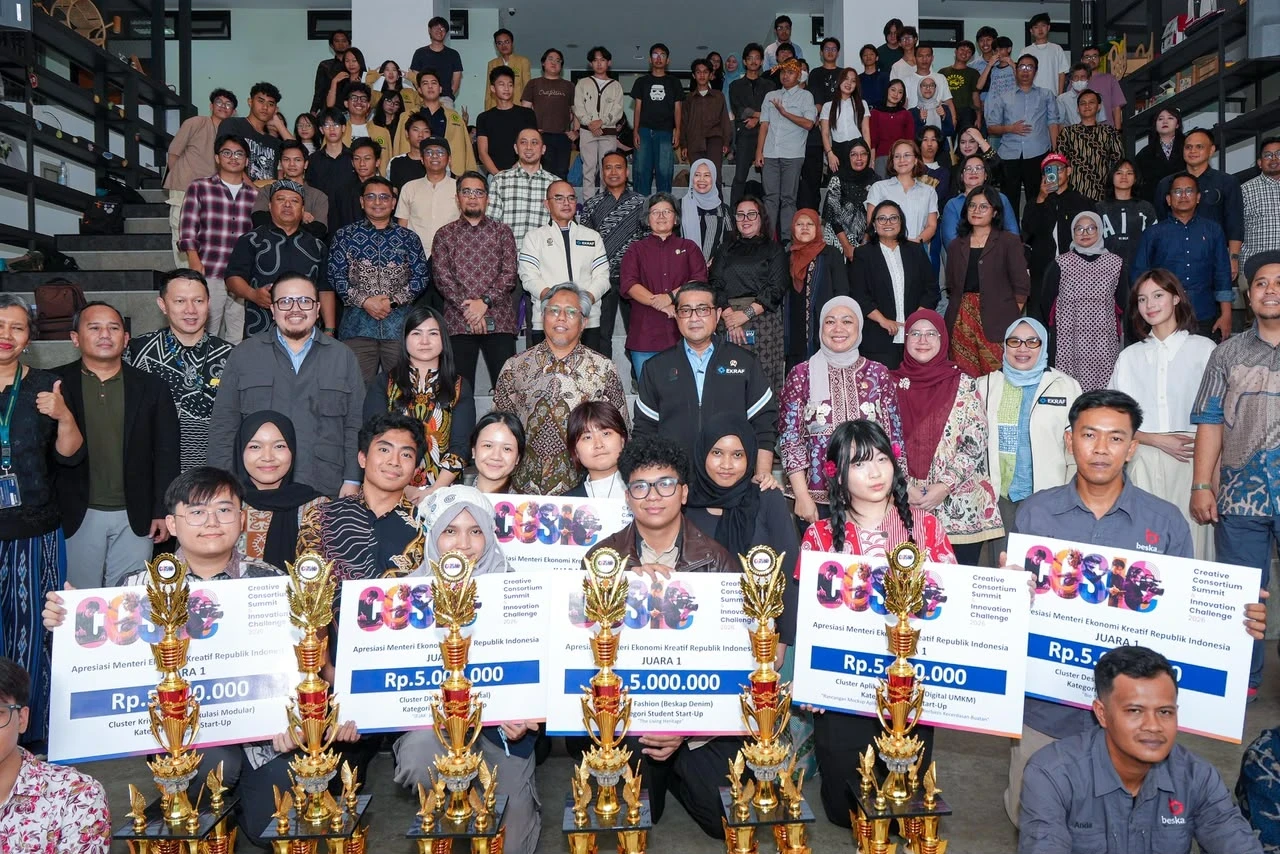
Jakarta, September 24, 2026 – Institut Teknologi Bandung (ITB) hosted an academic discussion to strengthen the substance of the Jakarta Vision as part of the Road to the World Conference on Creative Economy (WCCE) 2026 series, conducted through the Creative Consortium Summit & Innovation Challenge (CCSIC) 2026. The event, which was also attended by the Rector of ITB, Prof. Tatacipta Dirgantara, was organized by the Higher Education Consortium for Creative Economy (KPT Ekraf).
 Minister of Creative Economy/Head of the Creative Economy Agency (Ekraf), Teuku Riefky Harsya, delivers a keynote speech at the Creative Consortium Summit & Innovation Challenge (CCSIC) 2026 at the Bandung Institute of Technology (Institut Teknologi Bandung), Bandung, West Java, Thursday (24/09/2026).
In his keynote speech, the Minister of Creative Economy/Head of the Creative Economy Agency, Teuku Riefky Harsya, stated that the Jakarta Vision requires contributions from academicians so that the ideas brought by Indonesia to the global stage hold a strong foundation in knowledge, research, and innovation.
"The Jakarta Vision must be supported by academicians' ideas. We need a space to discuss, test ideas, and build a shared vision so that Indonesia's creative economy becomes stronger and capable of playing a strategic role globally," stated the Minister of Creative Economy at the Centre for Art, Design, and Language (CADL) Building, ITB, on Thursday (9/24).
According to him, the Jakarta Vision holds a strategic position as it will serve as one of the foundations for drafting the UN Resolution on the Creative Economy at the United Nations General Assembly.
 Photo: Bureau for Communication, Ministry of Creative Economy / Creative Economy Agency.
The Jakarta Vision encompasses four main clusters: technology, AI, and digital transformation; sustainability, circular economy, and regenerative design; inclusivity and community empowerment; and balanced Intellectual Property (IP) protection for creators.
"Indonesia's success is not measured only by hosting the WCCE 2026, but also by the key output in the form of the Jakarta Vision, which can offer new ideas and directions for the development of the global creative economy," stated Teuku Riefky.
The involvement of academicians is considered crucial because the creative economy is a strategic sector for job creation and young talent development. In 2025, the creative economy sector recorded the employment of around 27.4 million workers, with 63 percent coming from Generation Z and Millennials, and 58 percent being women workers.
 Photo: Bureau for Communication, Ministry of Creative Economy / Creative Economy Agency.
CCSIC 2026, attended by more than 100 stakeholders, was also marked by the signing of an MoU between the Higher Education Consortium for Creative Economy (KPT Ekraf) and Universitas Multi Data Palembang, Universitas Santo Borromeus, and Politeknik Manahijul Huda, as well as the presentation of awards to six winners of the technology innovation competition. The forum featured speakers such as Dr. Dwinita Larasati, Executive Committee of ICCN and Head of the Master of Design Study Program at Faculty of Arts and Design (FSRD) ITB, and Wahyu Wijayanto, Director of Tourism, Creative Economy, and Digital Economy at the Ministry of National Development Planning/Bappenas.
Through this forum, the government and universities encourage collaboration to enrich the substance of the Jakarta Vision while strengthening Indonesia's contribution to shaping the global creative economy agenda.
Accompanying the Minister of Creative Economy were the Senior Advisor to the Minister for Research, Education, and Inter-Institutional Relations, Dian Permanasari; Special Advisor to the Minister for Strategic Issues and Inter-Institutional Affairs, Rian Syaf; and Expert Staff to the Minister, Gemintang Kejora Mallarangeng.
Kiagoos Irvan Faisal
Head of Bureau for Communication
Ministry of Creative Economy / Creative Economy Agency