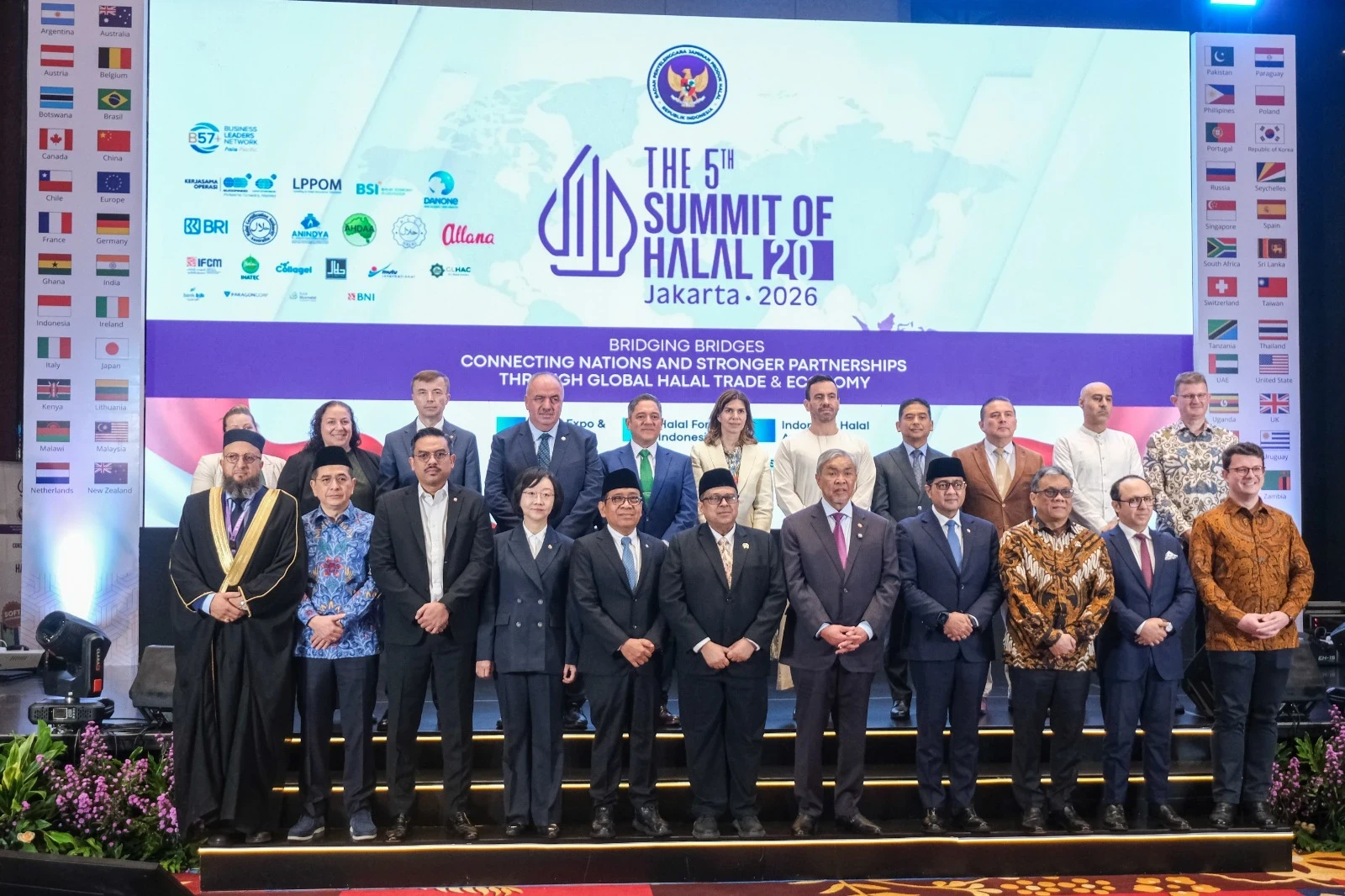
Jakarta, September 18, 2026 – Minister of Creative Economy/Head of the Creative Economy Agency (Ekraf), Teuku Riefky Harsya, attended the 5th Summit of Halal-20 (H20) 2026 at Trans Jakarta Hotel, Depok, Friday (18/9). The international forum, organized by the Halal Product Assurance Organizing Agency (BPJPH) of the Republic of Indonesia, was also attended by Deputy Prime Minister of Malaysia, Datu’ Seri Ahmad Zahid Hamidi.
 Minister of Creative Economy/Head of the Creative Economy Agency (Ekraf), Teuku Riefky Harsya, also opened the 5th Summit of Halal-20 (H20) 2026 at Trans Jakarta Hotel, Depok, Friday (18/9/2026).
In his remarks, Datu’ Seri Ahmad Zahid Hamidi stated that cooperation serves as the foundation for the sustainability of the halal industry. Muslim consumer spending across six key sectors of the Islamic economy reached approximately US$2.6 trillion in 2024 and is projected to reach US$3.56 trillion by 2029. Of this amount, the halal food sector accounted for more than US$1.33 trillion.
“However, what is more interesting is not merely the size of this market, but the various opportunities surrounding it, ranging from food, pharmaceuticals, cosmetics, tourism, logistics, technology, to finance. ASEAN holds a highly strategic position to capture this growth. With more than 250 million halal consumers, we already have the market scale, industries, and capabilities to become one of the major forces in the global halal economy,” said Datu' Seri Ahmad Zaid.
At the same event, Coordinating Minister for Human Development and Cultural Affairs (Coordinating Minister of PMK), Pratikno, stated that the Government of Indonesia continues to build an open and conducive economic ecosystem while ensuring consumer protection through halal product assurance.
“When credible halal certificates are mutually recognized between countries, businesses can reduce repetitive processes. Supply chains can become more efficient, while consumers receive stronger assurances. Mutual recognition can also create clearer pathways for small producers to enter international markets. Therefore, we need to build strong connectivity, as reflected in the theme of this conference,” said Pratikno.
Meanwhile, Minister of Creative Economy, Teuku Riefky Harsya, said that strengthening the halal economy is closely linked to the development of the creative economy, particularly in creating value-added products with distinct identities and competitiveness in global markets.
“We believe that halal certification is not only related to religious aspects, but also concerns health and lifestyle. Many creative industry players have opportunities to enter global markets through Indonesian halal certification, which has gained international recognition for its credibility,” said Teuku Riefky.
 Photo: Bureau for Communication, Ministry of Creative Economy / Creative Economy Agency.
H20 2026 serves as an international forum to strengthen halal cooperation and the halal ecosystem while encouraging the role of the creative economy in building an inclusive, transparent, and sustainable halal industry.
Under the theme “Bridging Bridges: Connecting Nations and Stronger Partnerships through Global Halal Trade & Economy,” the forum promotes dialogue, trust, and partnerships among countries to strengthen global halal standards and trade.
The contribution of the halal value chain to the national economy continues to increase. In 2025, the sector reached Rp6,400 trillion, or approximately 27 percent of gross domestic product (GDP), with 14 million products having obtained halal certification.
Head of BPJPH, Haikal Hassan, said that there are currently approximately 140,000 halal certification establishments in Indonesia. According to him, halal is not only related to religious aspects, but has also become a standard encompassing health, quality, transparency, and product traceability.
“Halal is now not only for Muslims. Halal is for everyone. Because halal speaks to health, transparency, and traceability. There is no higher standard than halal. So, let us promote it together,” said Haikal.
Also in attendance were Minister of Food and Drug Safety of the Republic of Korea, Yu-Kyoung Oh; ministers and heads of agencies in the Red and White Cabinet; the President’s Special Envoys; and several ambassadors of friendly countries. Minister of Creative Economy Teuku Riefky Harsya was accompanied by Secretary of the Deputy for Strategic Development of Creative Economy, Abdul Malik.
Kiagoos Irvan Faisal
Head of Bureau for Communication
Ministry of Creative Economy / Creative Economy Agency