Jakarta, September 30, 2026 – The Ministry of Creative Economy/Creative Economy Agency held the Creative Economy Media Editorial & Aspiration Forum (FRAME) as a space to bring together ideas and strengthen the media’s understanding of the direction of policies and priority programs for the development of the national creative economy. Minister of Creative Economy, Teuku Riefky Harsya, explained that FRAME serves as a crucial foundation for strengthening ties with media professionals while aligning the ministry’s agenda with the Asta Cita mandate.
 The Ministry of Creative Economy / Creative Economy Agency (Ekraf) holds the Forum Redaksi & Aspirasi Media Ekraf (FRAME) to strengthen relations with media professionals while aligning the Ministry’s agenda with the Asta Cita mandate, Jakarta (30/09/2026).
“This event aims to bring the media and the Ministry of Creative Economy closer together, as well as to provide a deeper understanding of the mandate entrusted to this ministry, and what we are currently doing and plan to do. In line with Asta Cita, the creative economy actually contributes to job creation for the younger generation and supports the middle class,” the Minister of Creative Economy said at the forum, which took place in the Senayan area of Jakarta on Wednesday (September 30).
Under the theme “United in Ideas, Empowering the Creative Economy,” FRAME is attended by 30 national media leaders, discussing the creative economy sector, which continues to demonstrate its vital role in the national economy. According to data from Statistics Indonesia (BPS), the Gross Domestic Product (GDP) of the creative economy reached Rp1,757.87 trillion, with a growth of 6.86%, exceeding the national economic growth rate of 5.11% and surpassing the 2025 National Medium-Term Development Plan (RPJMN) target by 124%. This sector is also the primary employer, dominated by the younger generations, Millennials (36.63%) and Gen Z (26.40%).
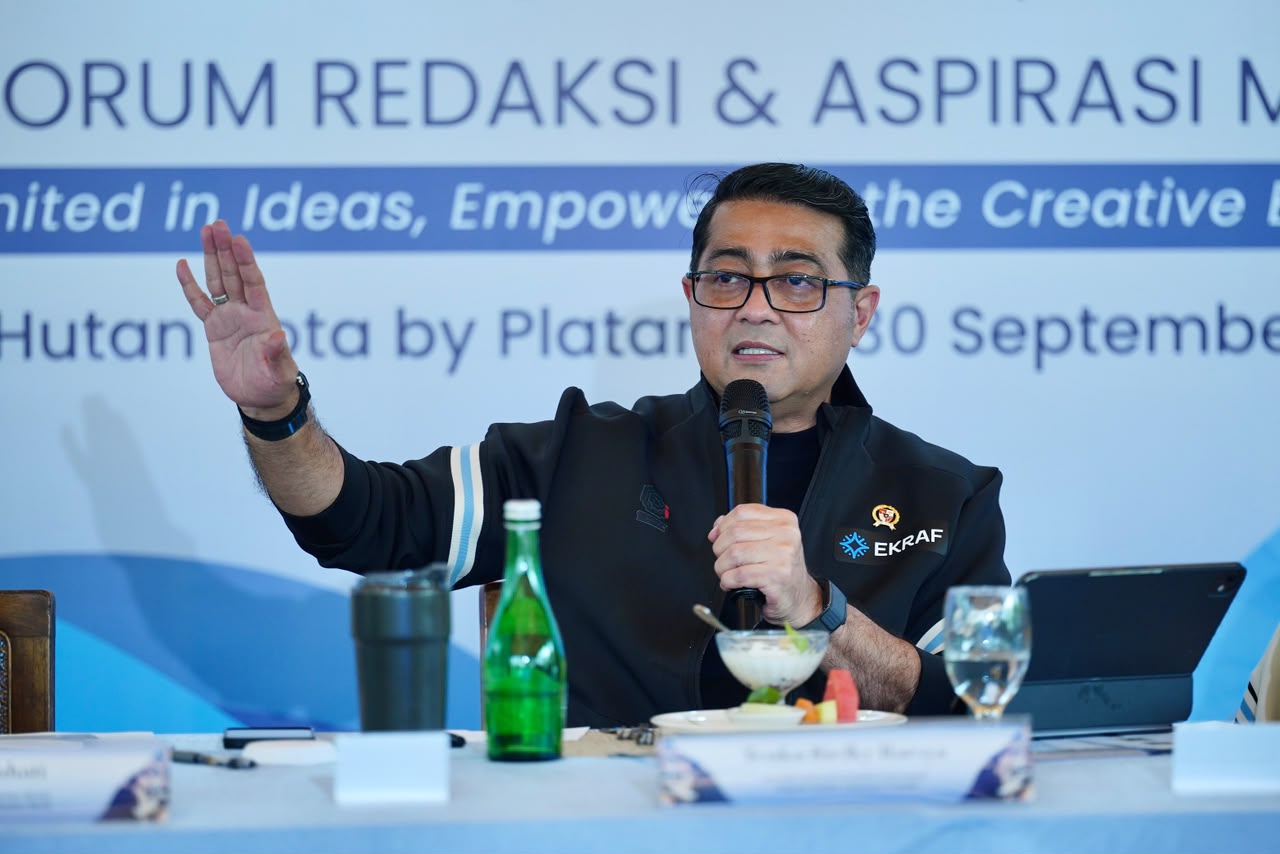 Photo: Bureau for Communication, Ministry of Creative Economy / Creative Economy Agency.
Looking toward the global stage, the Minister of Creative Economy emphasized the importance of strengthening intellectual property (IP) as an instrument of “soft diplomacy” and a driver of foreign exchange earnings.
“To reinforce this, the WCCE will be held because the government assigned the creative economy to serve as a tool for ‘soft diplomacy.’ So, we’re not just taking our arts and culture abroad, but also the IP from the creative economy to generate economic value that boosts the country’s foreign exchange earnings,” Teuku Riefky stated.
 Photo: Bureau for Communication, Ministry of Creative Economy / Creative Economy Agency.
Indonesia is scheduled to once again host the 5th World Conference on Creative Economy (WCCE) in 2026. This global forum aims to establish the “Jakarta Vision on Creative Economy” while mainstreaming the creative economy agenda in post-SDG 2030 global development through diplomacy and international collaboration.
Deputy Minister of Creative Economy, Irene Umar, added that the organization of WCCE 2026 will prioritize the hexahelix approach and a decentralized location strategy. Indonesia stands as the only country in Southeast Asia to fully implement the hexahelix approach, allowing international delegates to witness firsthand the full dynamics of Indonesia’s creative ecosystem.
 Photo: Bureau for Communication, Ministry of Creative Economy / Creative Economy Agency.
“This WCCE is intended to bring this resolution to the United Nations; furthermore, it serves as a platform where stakeholders—from government to business—will come together. Moreover, the WCCE features not only plenary sessions but also government-to-government (G2G) meetings,” the Deputy Minister of Creative Economy explained.
Support for this strategic initiative was also voiced by media leaders. Wahyu Kustyanto, Deputy Editor-in-Chief of TV One, noted that the creative economy possesses limitless potential worthy of becoming a main pillar of national economic growth.
 Photo: Bureau for Communication, Ministry of Creative Economy / Creative Economy Agency.
“The Ministry of Creative Economy is extremely important. It can serve as a pillar for Indonesia’s future economic growth. After all, creativity is endless, whereas natural resources are finite. So the state, the government, must take the creative economy very seriously,” Wahyu stated.
A similar view was expressed by MDTV’s Editor-in-Chief, Ponco Wijaya, who commended the ministry’s efforts to support the domestic broadcasting and film industries.
“The support provided by the Ministry of Creative Economy to the television and film industries is already excellent; communication channels have been established very quickly and are functioning very well,” Ponco said.
The FRAME forum proceeded productively, attended by Echelon I and Echelon II officials from the Ministry of Creative Economy.
Kiagoos Irvan Faisal
Head of the Communications Bureau
Ministry of Creative Economy/Creative Economy Agency