Jakarta, August 31, 2026 – The Ministry of Creative Economy / Creative Economy Agency (Ekraf) and Commission VII of the House of Representatives of the Republic of Indonesia (DPR RI) discussed the Ministry/Agency Work Plan and Budget (RKA-K/L) for Fiscal Year 2027 to align policies and budgetary support with national development priorities while expanding their impact on society.
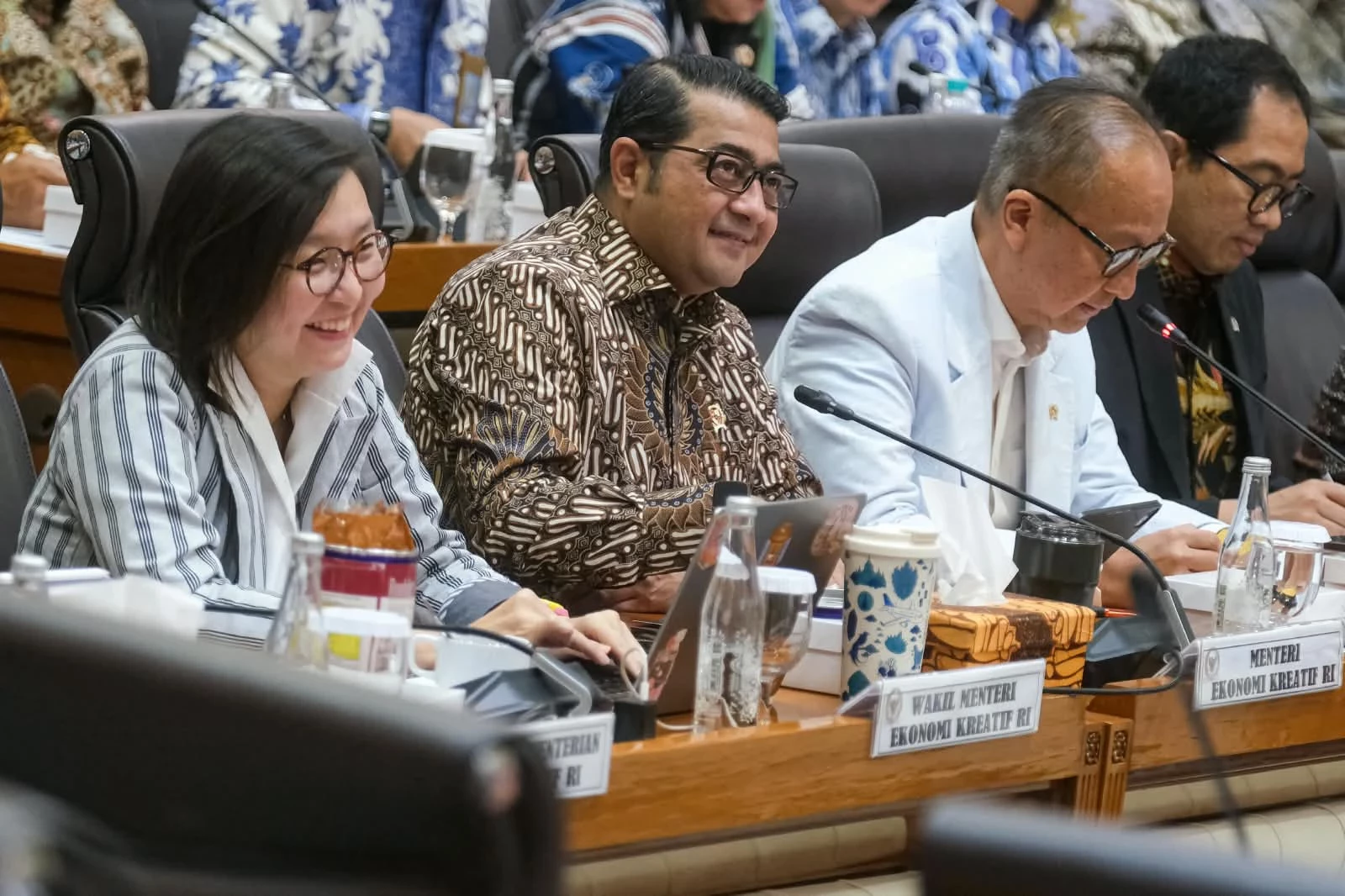
 Minister of Creative Economy/Head of the Creative Economy Agency (Ekraf), Teuku Riefky Harsya, and Deputy Minister of Creative Economy/Deputy Head of the Creative Economy Agency (Ekraf), Irene Umar, attended a working meeting with Commission VII of the House of Representatives of the Republic of Indonesia (DPR RI) to discuss strengthening policies and synergies in the development of the creative economy sector and national industry at the House of Representatives Complex in Jakarta, Monday (31/8/2026).
Minister of Creative Economy, Teuku Riefky Harsya, said that the creative economy plays a strategic role in supporting national economic growth. In 2027, the sector is targeted to contribute 7.1–7.24 percent to GDP growth, absorb 28.5–29.55 million workers, record export value of US$37.42–38.72 billion, and attract investment of Rp205.73–211.81 trillion.
“We will focus our programs and activities more closely on agendas that are directly aligned with the National Priority Work Programs (PKPN). Within this framework, the Ministry of Creative Economy contributes by strengthening productivity through improving the quality of creative economy talent, innovation, and digitalization; increasing investment by expanding access to IP-based financing and incentives; and strengthening the industry through the downstreaming of derivative creative products,” said the Minister of Creative Economy at the House of Representatives Complex in Jakarta, Monday (31/8).
Under the 2027 work plan, the Ministry of Creative Economy is prioritizing talent and entrepreneurship development, intellectual property development, digital capacity building, intellectual property-based financing, IP commercialization, and expanded market access. Several strategic programs are also directed toward supporting local heroes go national and national champions go global, including through strengthened exports, investment, and promotion of Indonesian IP.
 Photo: Bureau for Communication, Ministry of Creative Economy / Creative Economy Agency.
The Ministry of Creative Economy has also proposed strengthening the integration of the creative economy sector into the 2027 National Priority Work Programs (PKPN), particularly through the downstreaming of creative industries, as well as the activation of villages/sub-districts and creative spaces. This direction is in line with the 2027 Government Work Plan (RKP), which emphasizes accelerating quality growth through productivity, investment, and industry.
In presenting the 2027 RKA, the Minister of Creative Economy emphasized the importance of aligning targets and programs with the available budgetary support, particularly regarding the composition of Programs and Management Support. The proposed additional budget covers flagship creative economy development programs, non-operational and regular needs, as well as post-disaster rehabilitation and reconstruction in Sumatra.
“The additional budget for 2027 is aimed at strengthening creative economy development in a more integrated manner, ranging from regular programs and priority interventions for ecosystem development, capacity building for creative economy players, market access, financing, and investment, to strengthening Indonesia’s creative economy position nationally and internationally, as well as supporting the recovery of disaster-affected regions,” said Teuku Riefky.
Deputy Chairperson of Commission VII of the House of Representatives, Rahayu Saraswati Djojohadikusumo, said that the presence of the Ministry of Creative Economy and the Ministry of Industry was in line with the downstreaming of industry, which serves as a key driver for increasing value added and the multiplier effect. Commission VII of the House of Representatives supported and approved the Ministry of Creative Economy’s proposed additional budget of Rp1.73 trillion for the 2027 fiscal year.
 Photo: Bureau for Communication, Ministry of Creative Economy / Creative Economy Agency.
“I am very pleased that the Ministry of Industry and the Ministry of Creative Economy are here today because the two are very aligned and in line when it comes to downstreaming. This is the key driver for increasing value added. The creative economy clearly has an impact by generating value added, because the multiplier effect of value added is very significant,” said Rahayu.
Also present were Chairperson of Commission VII of the House of Representatives, Saleh Partaonan Daulay, along with the Deputy Chairpersons and members of Commission VII; Minister of Industry, Agus Gumiwang Kartasasmita; and Deputy Minister of Industry, Faisol Riza. The Minister of Creative Economy was accompanied by Deputy Minister of Creative Economy, Irene Umar, as well as several Echelon I and II officials of the Ministry of Creative Economy.
Kiagoos Irvan Faisal
Head of Bureau for Communication
Ministry of Creative Economy / Creative Economy Agency