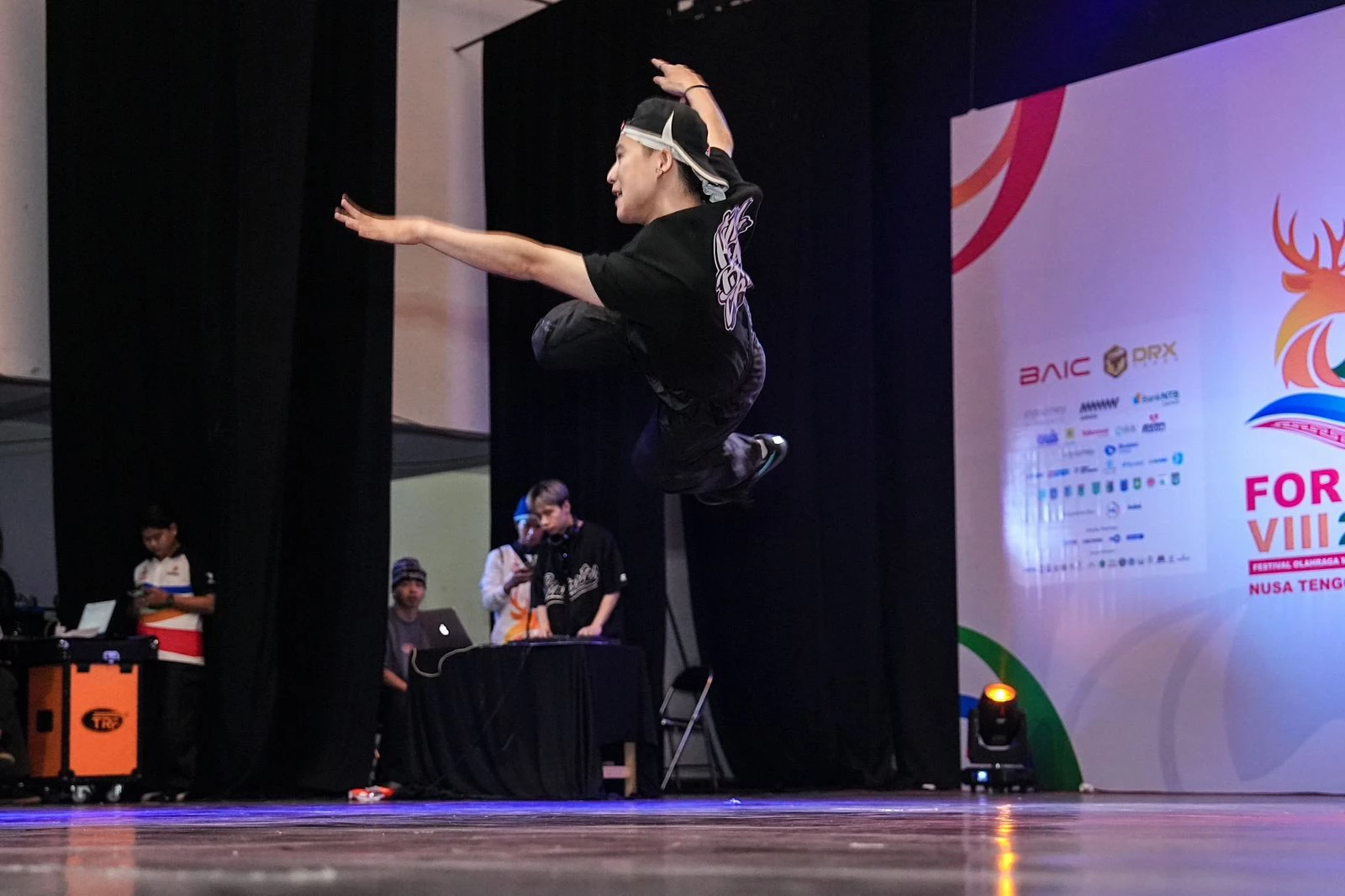
Mataram, July 27, 2025 — The Indonesian Federation of Dancesport & Breaking (FDBI) held an official competition as part of the 8th National Recreational Sports Festival (FORNAS) at Taman Budaya, Mataram, on July 26–27, 2025. The Ministry of Creative Economy reaffirmed its commitment to developing the creative economy as a driver of regional growth. Dok. Biro Dokumentasi Kemenekraf/Bekraf - Menteri Ekraf Teuku Riefky Harsya Berkomitmen Kembangkan Seni Pertunjukan dari Daerah, Mataram, Minggu (27/06/2025).
The event was attended by Coordinating Minister for Infrastructure and Regional Development Agus Harimurti Yudhoyono and Minister of Creative Economy Teuku Riefky Harsya, who both witnessed the competition firsthand. A total of 185 participants from 18 provinces competed across 11 categories in Dancesport, Breaking, and Street Dance, drawing around 150 enthusiastic spectators.
“The potential here is extraordinary. I personally enjoy sports and greatly admire the creativity of young people. We want to encourage communities like street dance to keep growing. In developed countries, arts and sports like this have significant economic impact,” said Minister Agus Harimurti Yudhoyono.
Minister of Creative Economy Teuku Riefky emphasized the importance of professional development for performing arts, particularly street dance. He noted that the demand for dance extends beyond festivals, also serving cultural, tourism, and regional pride events.
“This activity is a strategic platform for nurturing young talent and enhancing the quality of performing arts, from the local to the national and even global stage,” said Minister Riefky. Dok. Biro Dokumentasi Kemenekraf/Bekraf.
The ministry currently oversees 17 creative economy subsectors, divided into four clusters: culture, design, media, and digital technology. Performing arts, including street dance, are part of the culture-based cluster and receive dedicated attention.
“The street dance ecosystem is highly interconnected and multifaceted. It generates jobs across the board—from trainers and choreographers to costume designers and young talents. It is also closely linked with music, media, and entertainment,” Minister Riefky explained.
He further stressed the need for synergy between the government and creative communities to maximize the sector’s potential.
“We are ready to act as a partner in strengthening this subsector. Despite existing limitations, the government is committed to supporting the growth of the street dance ecosystem in Indonesia,” he added. Dok. Biro Dokumentasi Kemenekraf/Bekraf.
Ardiyansyah Djafar, Chairman of FDBI, expressed his appreciation for the central government’s attention. He noted that the global dance market is projected to reach USD 3.22 billion in 2025 and grow to USD 12.23 billion by 2033.
“In Indonesia, the potential market value for dance and cheerleading could reach IDR 4 trillion.
Unfortunately, the performing arts industry, especially dance, has not yet received significant attention, even though the potential is enormous,” said Ardiyansyah.
He further illustrated the value of the sector by citing the acquisition of Varsity Brands, a leading cheerleading products license holder, by KKR (Kohlberg Kravis Roberts & Co) for USD 4.75 billion at the end of 2024.
“We must view this as a creative economy opportunity that we can develop together,” Ardiyansyah emphasized.
Kiagoos Irvan Faisal
Acting Head of Bureau for Communications
Ministry of Creative Economy


