Yogyakarta, 25 April, 2026 – The Minister of Creative Economy/Head of the Creative Economy Agency, Teuku Riefky Harsya, stated that the local game industry holds significant potential for growth and sustainability. One developer that exemplifies this potential is KuloNiku, created by Gambir Studio in Sleman, Special Region of Yogyakarta.
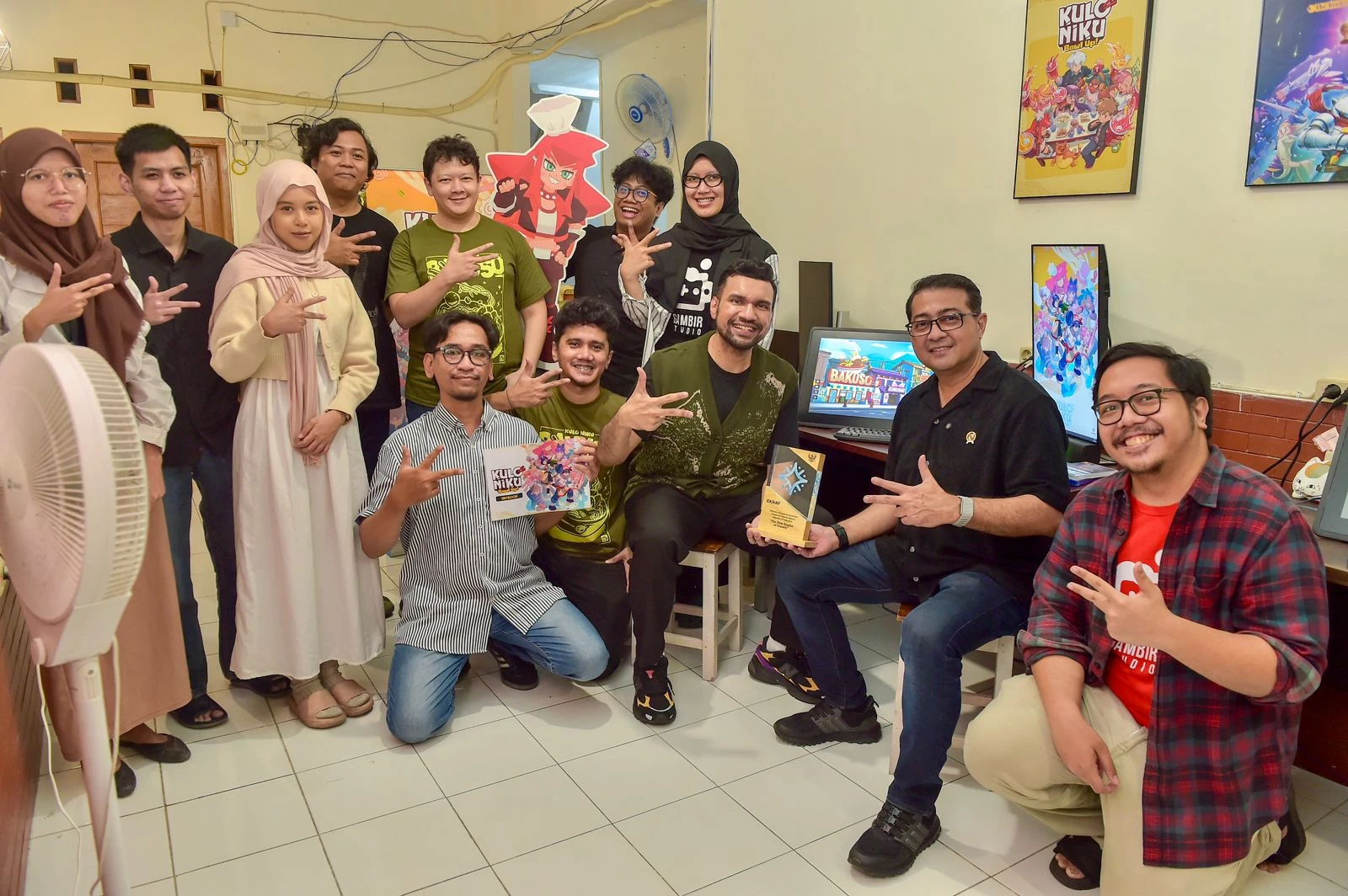
 The Minister of Creative Economy, Teuku Riefky Harsya, conducted a working visit to Gambir Studio, Yogyakarta, on Saturday (25/4/2026).
“Today, I visited Gambir Studio to directly see the KuloNiku game. In less than two weeks since its launch, the game has reached nearly 60,000 users. This demonstrates that local games have great potential to grow and become a new economic force,” said the Minister of Creative Economy during his visit to Gambir Studio, Sleman, Yogyakarta, on Saturday (25/4).
The Minister of Creative Economy engaged in discussions with the founders of Gambir Studio and directly tried the newly released game, KuloNiku: Bowl Up!. He also highlighted the importance of policy support in strengthening the national game industry ecosystem.
 Documentation: Bureau for Communication of the Ministry of Creative Economy/Creative Economy Agency.
“We continue to conduct discussions regarding incentives, studies, and regulations to strengthen the game subsector. It is hoped that these policies will address industry needs while encouraging creative players not only to survive, but also to grow and achieve greater prosperity,” he stated.
Established in 2016, Gambir Studio has released more than 12 game titles with over 20 million total downloads. Based in Yogyakarta, the studio incorporates local richness into its works, including Indonesian cuisine, which serves as the main inspiration for KuloNiku.
 Documentation: Bureau for Communication of the Ministry of Creative Economy/Creative Economy Agency.
On the other hand, the Chief Executive Officer of Gambir Studio, Shafiq Husein, conveyed that the development of KuloNiku was closely linked to the momentum of participation in Gamescom 2025, which was part of government support in opening access to the international ecosystem, thereby encouraging collaboration with publishers and accelerating the release process.
“We do not only create games, but also carry a cultural mission. There is a collaboration between culinary arts, animation, and games. This proves that the creative economy cannot stand alone, but must grow through collaboration,” he explained.
 Documentation: Bureau for Communication of the Ministry of Creative Economy/Creative Economy Agency.
The Minister of Creative Economy also emphasized that Gambir Studio, as a developer that has grown from the regions, demonstrates the strong potential of a locally based creative economy. Through KuloNiku, game development goes hand in hand with the promotion of Indonesian culture and cuisine, thereby creating cross-subsector impacts within the creative economy ecosystem.
In addition, the Minister highlighted the continuing growth trend of the national game industry, with more than 40 local games released in the past year. Emphasis was placed on the importance of quality and sustainability to ensure that Indonesian games not only exist, but are able to endure and establish a strong position in the market.
 Documentation: Bureau for Communication of the Ministry of Creative Economy/Creative Economy Agency.
The Ministry of Creative Economy reaffirmed its commitment to strengthening the game subsector by encouraging the emergence of more studios from various regions across Indonesia to scale up and penetrate the global market. This effort forms part of a broader strategy to position the creative economy as the new engine of growth, driven by innovation, cross-sector collaboration, and the strengthening of local talent.
Also accompanying the Minister of Creative Economy during the visit was the Director of Games, Luat Sihombing.
Kiagoos Irvan Faisal
Head of Bureau for Communication
Ministry of Creative Economy/Creative Economy Agency


