
Jakarta, June 2, 2026 – Minister of Creative Economy/Head of the Creative Economy Agency, Teuku Riefky Harsya, announced that Indonesia’s creative economy sector delivered positive performance in the first quarter of 2026. The achievement was presented during a working meeting on the First Semester Performance Report and Budget Absorption with Commission VII of the House of Representatives (DPR RI) at the Parliament Complex in Senayan, Jakarta, on Tuesday (2/6).
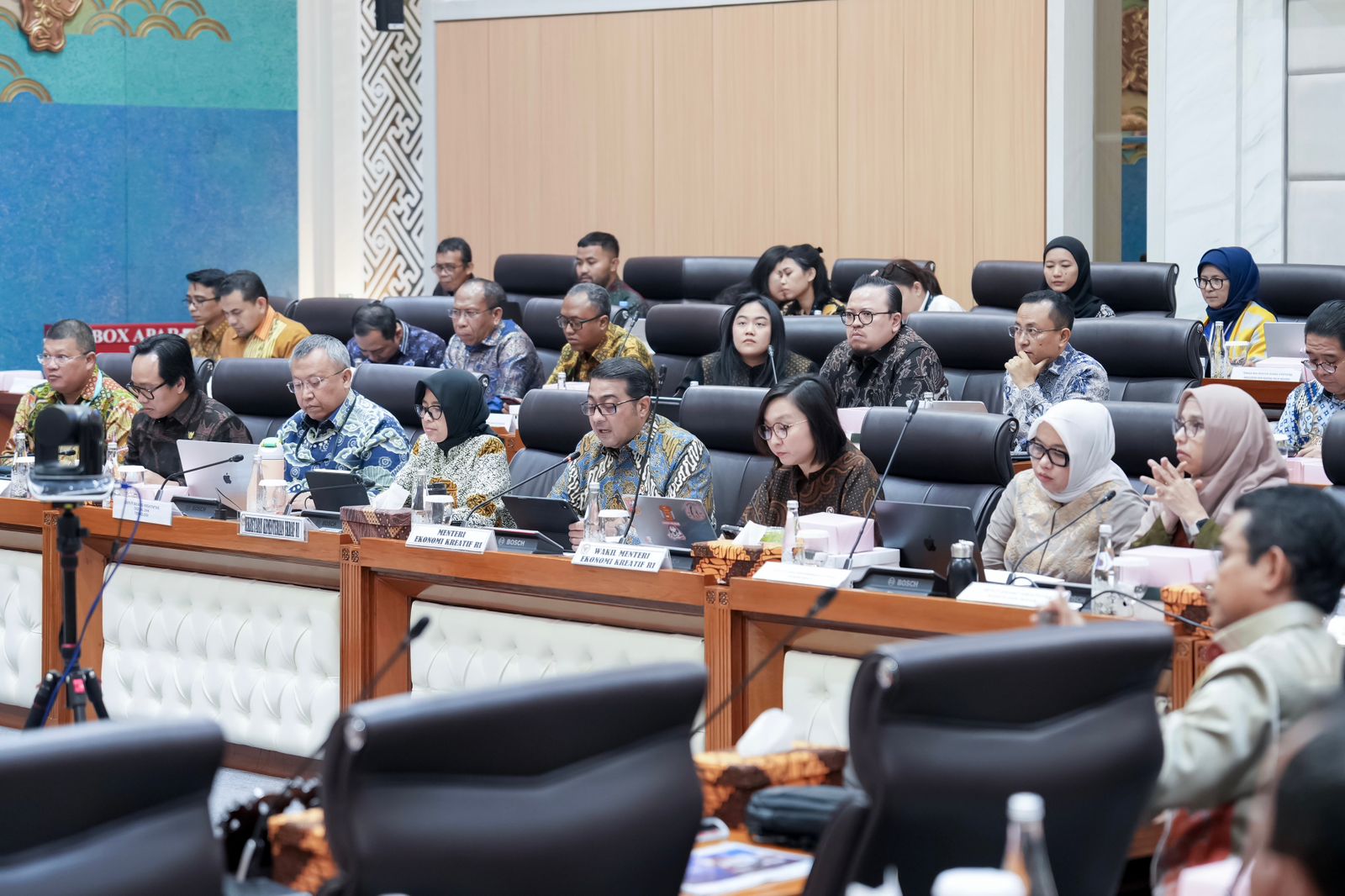
 Minister of Creative Economy Teuku Riefky Harsya, accompanied by Deputy Minister of Creative Economy Irene Umar, attended a working meeting on the First Semester Performance Report and Budget Absorption with Commission VII of the House of Representatives (DPR RI) at the Parliament Building, Senayan, Jakarta, Tuesday (2/6/2026).
The positive performance was reflected in the realization of investment in the creative economy sector, which reached IDR 61.33 trillion, equivalent to 47 percent of the 2026 annual target. The figure marked a significant increase compared to the same period in 2025, when investment stood at IDR 43.3 trillion.
“This represents a 42 percent year-on-year increase in investment. By subsector, the largest investments remain concentrated in applications, culinary arts, fashion, crafts, and advertising,” said Teuku Riefky.
In addition to investment growth, positive performance was also evident in creative economy exports, which reached USD 7.38 billion in the first quarter of 2026, equivalent to 27 percent of the annual target. The largest contributions came from the fashion, crafts, and culinary subsectors.
“On a monthly basis, export values from January, February, to March showed a consistent upward trend. In terms of contribution to the national economy, creative economy exports accounted for 11.8 percent of Indonesia’s total non-oil and gas exports in March 2026,” he explained.
 Doc. Bureau for Communication, Ministry of Creative Economy/Creative Economy Agency.
During the meeting, Teuku Riefky also highlighted several achievements of the Ministry of Creative Economy, including the implementation of the royalty tax incentive policy for authors, strengthened access to intellectual property (IP)-based financing, and the development of the Ekraf Hub program.
Meanwhile, Chair of Commission VII of the House of Representatives, Saleh Partaonan Daulay, stated that the growth of the creative economy has the potential to drive the development of other economic sectors. He expressed confidence that the sector would continue to expand, particularly given Indonesia’s abundance of young talent with strong creative potential.
“I am convinced that when the creative economy grows and thrives, other sectors will follow. If this sector advances, the others will naturally be pulled along. What may appear small today could become something significant tomorrow, especially in the field of technology,” he said.
Commission VII member Nila Yani Hardiyanti also commended the Ministry’s performance, particularly in increasing exports of creative products. However, she emphasized the importance of complementing these achievements with efforts to enhance the long-term economic value of culture-based intellectual property (IP).
 Doc. Bureau for Communication, Ministry of Creative Economy/Creative Economy Agency.
“If we succeed in building strong intellectual property, its economic value can be sustained through licensing, merchandise, games, and various derivative products. Indonesia possesses an extraordinary wealth of cultural assets,” she said.
At the working meeting, the Minister of Creative Economy was accompanied by Deputy Minister of Creative Economy Irene Umar, Secretary of the Ministry of Creative Economy Dessy Ruhati, and senior officials of the Ministry of Creative Economy.
Kiagoos Irvan Faisal
Head of Bureau for Communication
Ministry of Creative Economy/Creative Economy Agency


