
Jakarta, 15 June 2026 – Minister of Creative Economy/Head of the Creative Economy Agency, Teuku Riefky Harsya, presented the policy direction and work plan of the Ministry of Creative Economy for Fiscal Year 2027 during a Working Meeting with Commission VII of the House of Representatives (DPR RI) on the discussion of the 2027 Government Work Plan (RKP) and the Ministry/Agency Budget Work Plan (RKA-K/L).
 Minister of Creative Economy Teuku Riefky Harsya, accompanied by Deputy Minister of Creative Economy Irene Umar, attended the working meeting at the Nusantara I Building, Jakarta, on Monday (15/6/2026).
During the meeting, the Minister introduced three flagship programs proposed as the focus of national creative economy development in 2027.
“We are proposing Creative Villages, Creative Hubs, and Creative by Indonesia as the Ministry’s flagship programs for 2027. Through these initiatives, we aim to ensure that the creative economy sector makes tangible contributions to increasing investment and exports, creating jobs, reducing poverty, and accelerating the achievement of the national economic growth target of 8 percent by 2029,” said Minister Teuku Riefky Harsya.
In addition, the Ministry proposed government assistance to strengthen creative production facilities and infrastructure for creative economy players and communities, as well as institutional strengthening and creative economy diplomacy to expand market access and international cooperation.
 Photo: Bureau of Communications, Ministry of Creative Economy/Creative Economy Agency.
The 2027 flagship programs have been designed to support the targets set out in the 2025–2029 National Medium-Term Development Plan (RPJMN), particularly those outlined in the 2027 Government Work Plan (RKP). These targets include 5.8 percent growth in the creative economy’s contribution to GDP, export growth of 5.5 percent with a value reaching USD 29.39 billion, employment absorption of up to 26.58 million workers, and an increase in creative economy investment to Rp157.65 trillion. These targets reaffirm the role of the creative economy as a new engine of growth supporting national economic transformation driven by creativity and innovation.
Teuku Riefky further explained that the Ministry’s proposed programs and budget for 2027 align with the theme of the 2027 Government Work Plan: “Accelerating Quality Growth through Productivity, Investment, and Industry.” Through strengthening creative talent, promoting creativity based on Intellectual Property (IP), generating employment opportunities, developing villages and regions, and enhancing the competitiveness of national products, the creative economy sector is expected to become one of the key drivers of inclusive and sustainable economic growth.
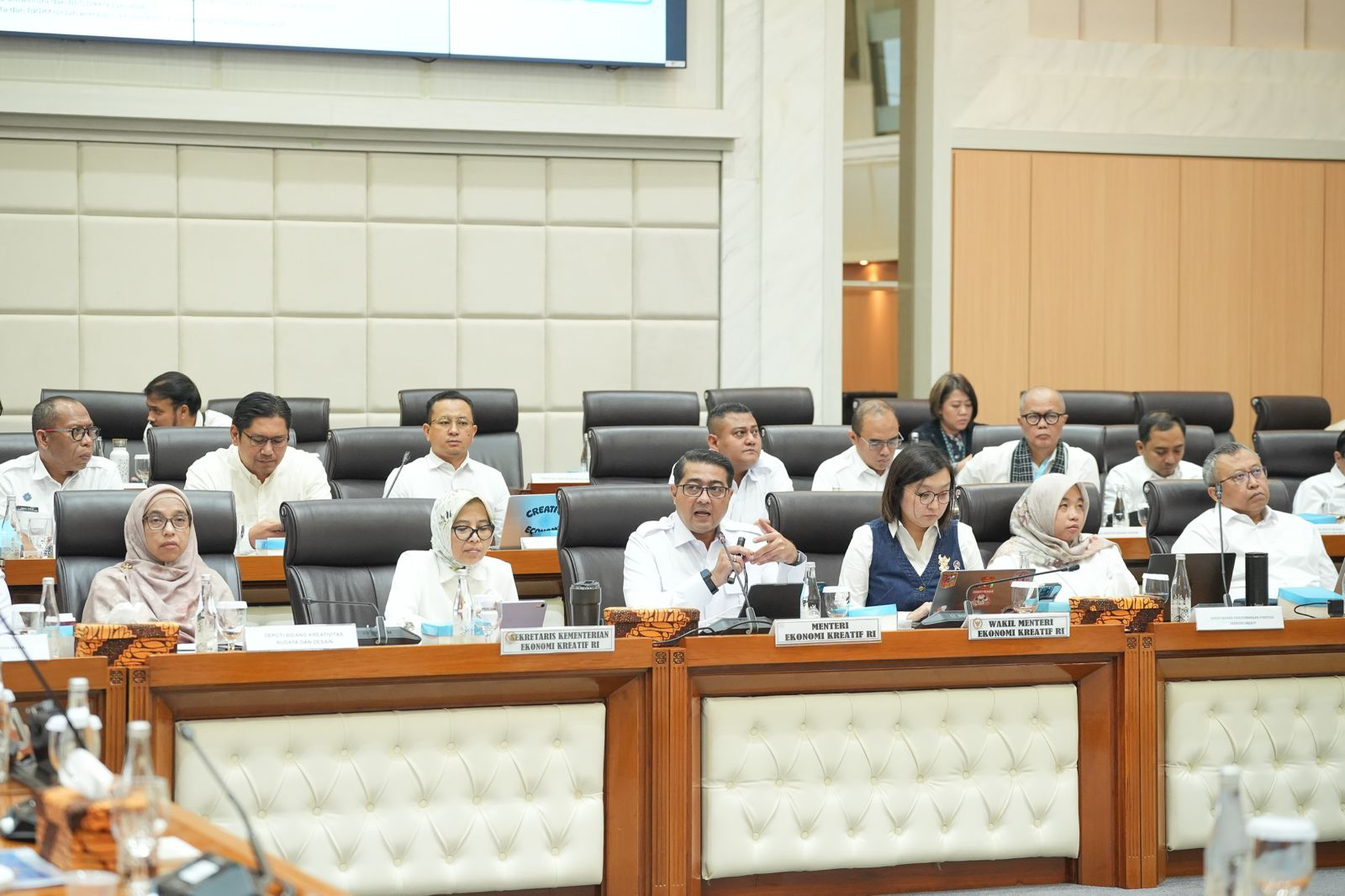 Photo: Bureau of Communications, Ministry of Creative Economy/Creative Economy Agency.
Responding to the presentation, the leadership of Commission VII of the DPR RI expressed appreciation for the Ministry’s efforts to strengthen the contribution of the creative economy sector to the national economy. Commission VII also emphasized the importance of designing measurable and well-targeted programs that deliver tangible benefits to public welfare and enhance the competitiveness of Indonesia’s creative products.
“I am confident that members of Commission VII will support programs whose benefits can be directly felt by the public. With regard to the Creative Village initiative, what matters most is having clear data and implementation mechanisms, even if it overlaps with other programs such as Tourism Villages. I also appreciate the Minister’s openness to various inputs, ensuring that the policy direction being developed is on the right track to strengthen Indonesia’s creative economy as an increasingly competitive instrument of soft power,” said Deputy Chairperson of Commission VII of the DPR RI, Rahayu Saraswati Djojohadikusumo.
 Photo: Bureau of Communications, Ministry of Creative Economy/Creative Economy Agency.
The meeting concluded with Commission VII of the DPR RI acknowledging and further reviewing the proposed programs and budget requirements submitted by the Ministry of Creative Economy as part of the deliberation process for the 2027 Ministry/Agency Budget Work Plan (RKA-K/L).
During the working meeting, the Minister was accompanied by Deputy Minister of Creative Economy Irene Umar; Secretary of the Ministry of Creative Economy/Chief Secretary of the Creative Economy Agency, Dessy Ruhati; as well as senior officials of the Ministry of Creative Economy.
Kiagoos Irvan Faisal
Head of Bureau of Communications
Ministry of Creative Economy/Creative Economy Agency


