
Jakarta, 22 January 2026 — The Ministry of Creative Economy / Creative Economy Agency together with Commission VII of the House of Representatives of the Republic of Indonesia (DPR RI) held a working meeting to discuss the 2025 performance evaluation as well as the 2026 work program plan of the Ministry of Creative Economy. The meeting served as a strategic forum to align policy direction, performance targets, and budgetary support in order to strengthen the contribution of the creative economy to the national economy.
 The Minister of Creative Economy, Teuku Riefky Harsya, presented the achievement of the 2025 Key Performance Indicators (KPI) during the working meeting with Commission VII of the DPR RI at the DPR Building, Senayan, Jakarta, Thursday (22/1/2026).
During the working meeting held at the DPR RI Building, Jakarta, Minister Teuku Riefky Harsya expressed his appreciation to Commission VII of the DPR RI as the Ministry’s main working partner in strengthening the creative economy sector. He emphasized that the working meeting represents a form of public accountability as well as a shared evaluation space to assess achievements and challenges in developing the national creative economy ecosystem.
Based on the key performance indicators, creative economy investment in 2025 reached Rp132.04 trillion, exports amounted to USD 29.21 billion, and employment absorption reached 27.4 million workers. Meanwhile, official figures for GDP growth are still awaiting recapitulation from Statistics Indonesia (BPS).
“Overall, the performance of the creative economy in 2025 showed a very positive trend and exceeded most of the targets set in the National Medium-Term Development Plan (RPJMN). This is reflected in the achievement of key performance indicators as tangible impacts of sustained ecosystem strengthening,” he stated on Thursday (22/1/2026).
In addition to performance achievements, the Ministry of Creative Economy continues to strengthen its institutional foundations. These efforts include the signing of a joint decree with the Ministry of Home Affairs regarding the establishment of creative economy offices at the regional level. Regulatory strengthening has also been pursued in collaboration with ministries/agencies and financial institutions to develop intellectual property valuation services and IP-based financing, marked by the signing of dozens of memoranda of understanding across hexahelix stakeholders.
 Doc. Bureau for Communication, Ministry of Creative Economy / Creative Economy Agency
Entering 2026, the Ministry of Creative Economy has established the Asta Ekraf program clusters, which include talent strengthening, market development, financing, infrastructure, data, policy, and intellectual property. The main objectives are directed toward increasing the capacity of enabling factors, enhancing sectoral contributions to the economy, and advancing bureaucratic reform. Performance indicators include investment, exports, employment absorption, GDP growth, and the bureaucratic reform index.
Several strategic programs have been prepared, including the Ekraf Business Forum, the World Conference on Creative Economy 2026, acceleration of Indonesian creative exports, digital marketing training, creative entrepreneurship development, strengthening IP-based financing, and business competitiveness acceleration through the AKTIF program. All initiatives are designed to expand the impact of the creative economy in an inclusive and sustainable manner.
During the meeting, the Minister also conveyed several policy needs to accelerate sectoral transformation.
 Doc. Bureau for Communication, Ministry of Creative Economy / Creative Economy Agency
“To ensure that the creative economy truly becomes a driver of national economic growth starting from the regions, we request support for the revision of Law Number 24 of 2019 on the Creative Economy, the revision of Law Number 23 of 2014 on Regional Government so that the creative economy sector can be elevated as a governmental affair, the acceleration of the enactment of the Presidential Regulation on the Creative Economy Master Plan 2026–2045, as well as the proposal for additional budget allocation in 2026 to support the President’s priority programs,” he emphasized.
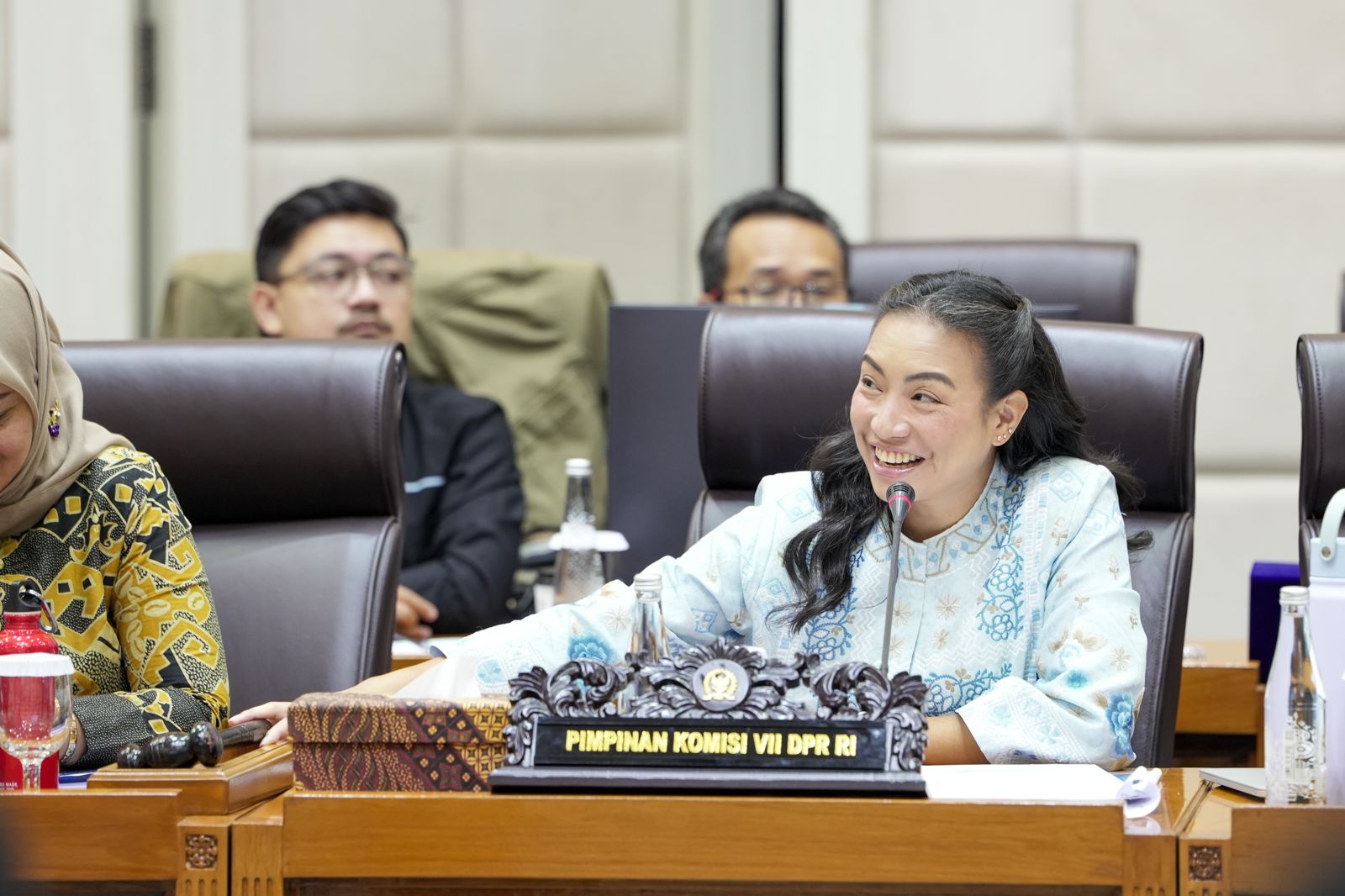
Acting as Chair of the Working Meeting, Vice Chair of Commission VII of the DPR RI, Rahayu Saraswati, stated that the 2025 performance evaluation is crucial as a shared reflection to assess the extent to which the Ministry’s policies and programs have aligned with established targets, while also identifying challenges, constraints, and opportunities for strengthening the creative economy ecosystem going forward.
“I appreciate this, especially with the issuance of the Ministerial Regulation on intellectual property valuers. In addition, regarding the establishment of creative economy offices, we must support this immediately and convey it to our colleagues in related commissions,” she said.
In the same forum, Commission VII DPR RI Member Rico Sia also welcomed the Ministry’s 2025 performance positively. Based on the presentation and achievements outlined, he expressed optimism that the creative economy sector will continue to grow.
 Doc. Bureau for Communication, Ministry of Creative Economy / Creative Economy Agency
“I extend my appreciation to the Minister and the entire team. I also appreciate the ecosystem-strengthening programs and strategic development across all areas presented in a comprehensive, engaging manner that fosters pride and optimism for a better future,” he stated.
The Ministry of Creative Economy reaffirmed its commitment to strengthening synergy with the DPR RI and all stakeholders to ensure the effective implementation of the 2026 work programs, deliver direct impact for creative business actors, and enhance national economic competitiveness amid global dynamics.
 Doc. Bureau for Communication, Ministry of Creative Economy / Creative Economy Agency
The Minister of Creative Economy was accompanied by the Secretary of the Ministry / Secretary-General of the Ministry of Creative Economy, Dessy Ruhati, along with the Ministry’s leadership team.
Kiagoos Irvan Faisal
Acting Head of the Bureau for Communication
Ministry of Creative Economy / Creative Economy Agency


